
How to find Dog-friendly Dispersed Camping Sites in Colorado
Is there anything better than the sound of tires crunching on a gravel road, leaving the highway (and the chaos) far behind? The answer is no, of course! Those first few wheel turns off the pavement towards dog-friendly dispersed camping sites are your sign that adventure is near! Add in the excitement of the dogs tails thumping in anticipation of “The Great Outside,” and you have the recipe for the perfect weekend.
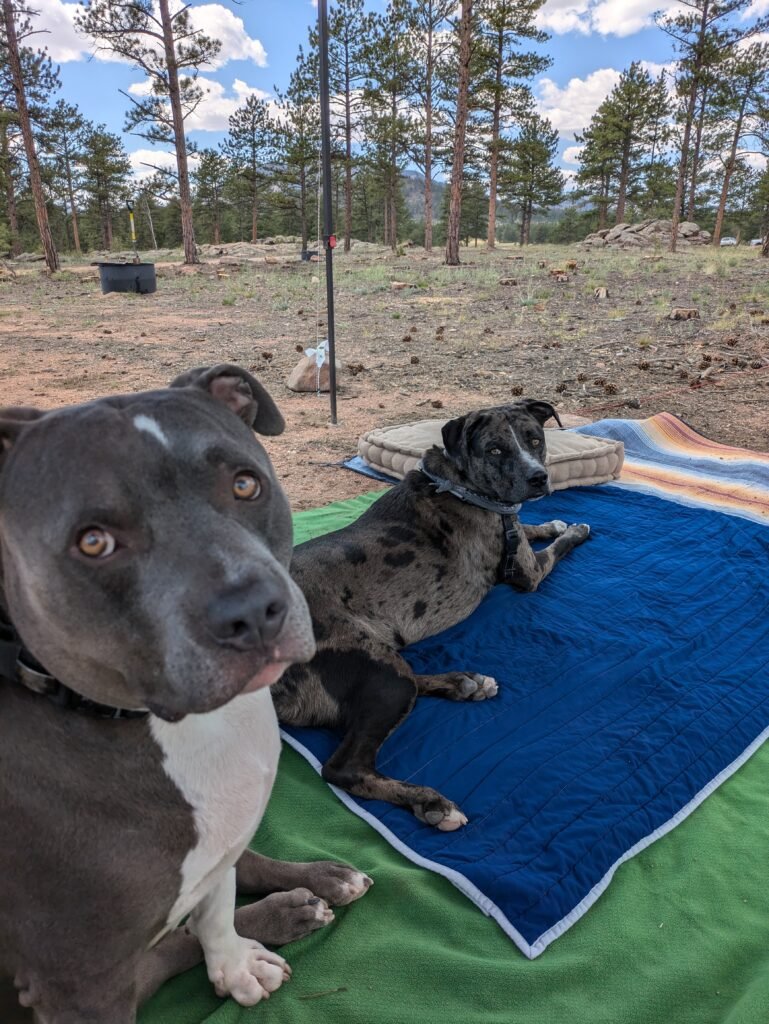
We aren’t talking about cramped RV parks where your neighbor’s sewer hose is three feet from your picnic table. We’re talking about dispersed camping – also known as boondocking. It’s the art of finding a slice of public land, parking your rig for free, and letting the dogs be dogs.
However, when you are navigating a large RV while looking for dog-friendly dispersed camping sites while managing multiple and/or massive “fur-missiles,” you can’t just turn down any random dirt road. You need a strategy. You need to know the ground is safe for the paws, the road is safe for the rig, and the views are worthy of your time and efforts.
Here is our ultimate guide to hunting down the best dog-friendly dispersed camping sites in the Centennial State!
The “Boondocking” Basics: What Are We Looking For?
Before you fire up the engine, let’s define the mission. In Colorado, the holy grail of dispersed camping is typically found on Bureau of Land Management (BLM) land or in National Forests.
The Pros: Space: No neighbors super close by (usually). Cost: It’s free! Usually 14-day stay limits are the maximum. Freedom: The dogs have room to sniff, roll, and patrol without as much chance of having to be aware of strangers or other dogs.
The Cons: No Hookups: You are relying on your batteries, maybe solar, your onboard water tanks and propane, and let’s not forget the limit in that all important black tank! Rough Roads: Washboard roads can rattle your teeth (and your RV dishes). Wildlife: You are in their house now.
The Digital Scout – things to do and consider before you even leave the house to try to find dog-friendly dispersed camping sites. Never turn a wheel without doing some digital reconnaissance. Getting a 30-foot RV stuck down a dead-end trail with no turnaround is a nightmare you definitely want to avoid.
1. Master the Motor Vehicle Use Map (MVUM)
The Motor Vehicle Use Map (MVUM) is your bible, and like every bible, it’s free. You can get as many as you want at the National Forest websites. Also, there are online resources as well such as apps like Gia GPS or AllTrails. They tell you exactly which forest roads allow dispersed camping (look for the dots on the side of the road on the map).
Pro Tip: If the map shows a road is strictly for “High Clearance 4×4,” believe it. You haven’t lived until you’ve bottomed out a Class C RV in a place it never should have been and then had to dig it out….
2. Use Satellite View When Looking for Dog-friendly Dispersed Camping Sites
Once you find a potential spot on your map or app, immediately switch to Google Earth or Satellite View on your mapping app. Zoom from a birds eye view all the way down to the route level, and even down to the campsite level if your app supports that.
Look for: Turnarounds: Is there a wide clearing at the end or a pull-through to get out? Vegetation: Are there low-hanging branches that will scrape your prized RV? The “Yard”: Is the area around the potential dispersed camping site covered in cactus, deep ruts, or other debris that can cause bad times on your trip? (More on that later).
3. Internet Connectivity Out in the Wild
If you work from the road, want to stream a movie on a rainy night, or just can’t live without that safety net back to civilization, be sure to check coverage maps for your provider. Many people rely on Starlink and it definitely has its perks. However, having a backup provider is not a bad idea, especially if you frequently go WAY off the grid.
Tech Tip: Reliable internet is a safety feature, too. If you have an emergency while at dog-friendly dispersed camping sites, or if you stepped too close to something wild that didn’t like you, you might need the option of being able to call for help.
4. Assessing the “Dog Factor” when Dispersed Camping
You’ve found a spot that looks great on a map. You’ve successfully navigated the washboard road without shaking the microwave off the wall. Now, before you unhitch or put the jacks down, you have to assess the site through the eyes of a dog.
Hop out of the rig and walk the site. Do not skip this step!
1. The Cactus Scan: In many lower-elevation BLM areas (like near Fruita or Canon City), prickly pear cactus is everywhere. It hides in the grass and is a nightmare for paw pads. If the “yard” is a minefield of spines, move on. It’s not worth the vet bill or discomfort your pups will feel.
2. The Shade Situation: Colorado sun at 9,000 feet above sea level is intense. If you are dispersed camping in the summer, you need natural shade for the dogs if you plan on sitting outside. If there are no trees, ensure you have a good awning setup on your rig, and bonus points for a pop up camping tent that can be moved to where it provides the most shade..
3. The “Roll” Factor: Look for ant hills (red ants bite hard!) and foxtails. Foxtails are those nasty grass seeds that burrow into dog ears and paws. If the site is overgrown with them, it’s a definite no-go.
5. Gear Up for Success at Dog-friendly Dispersed Camping Sites
Dispersed camping with dogs requires a few specific pieces of gear to keep things running smoothly. Here are a few things you should never leave the driveway without.
The “Patrol Zone”
Even in the middle of nowhere, you shouldn’t always let the dogs roam 100% free, especially at dusk when coyotes are active. We create a “courtyard” using a portable dog playpen. It gives them freedom to sniff the air without wandering off to chase a deer.
The FXW Rollick Dog Playpen for RV Camping. It’s tall enough for dispersed camping with big dogs and it also creates a safe barrier around the RV door.
The Dirt Defense
Let’s be real: boondocking at dog-friendly disbursed camping sites is dusty. If it rains, it’s muddy. To stop the Colorado clay from ruining your RV interior, you need a defense system at the door. Use a paw washer frequently before the pups come inside.
The Dexas MudBuster Portable Dog Paw Cleaner gets the grit out from between the toes better than a towel ever could.
Hydration Station
When you’re off-grid, water suddenly becomes very valuable. Dogs drink a lot of water, especially after hiking at altitude, and if your dogs are big, even more water will be needed. You should always carry extra water for both the dogs and for the humans so you don’t drain your RV’s fresh tank too fast.
The Reliance Products Aqua-Tainer 7 Gallon is rugged, stackable, and holds enough water for a long weekend of thirsty pups.
Nighttime Visibility
Dispersed camping with dogs is dark. Like, can’t-see-your-hand-in-front-of-your-face dark. If you let the dogs out for a final potty break, you need to be able to see where they are. Equip your dogs with light-up collars or rechargeable LED beacons.
The Nite Ize SpotLit Rechargeable LED Collar Light clips right onto your dogs existing collar and changes colors so you can tell which dog is which in the dark!
A Place to Rest
The ground in Colorado is often rocky or cold. Bring elevated cots or dog beds for the dogs to use outside. You know dogs are stubborn and will often refuse to retreat to the climate controlled camper because they have to guard their human – or they just have severe FOMO. An elevated surface keeps them off the hot dirt in summer and off the cold ground in autumn.
The Coolaroo Original Cooling Elevated Pet Bed is durable, easy to spray off with a hose, and allows airflow underneath.
6. Safety & Wildlife Awareness at Dog-friendly Dispersed Camping Sites
This is a big one. Colorado is home to black bears, moose, mountain lions, elk, and numerous other wild critters that will see a dog as a snack, a threat, or both!
Wildlife Etiquette:
- Food Storage: Never, ever leave dog food outside. It attracts bears and skunks. Feed the dogs, then bring the bowls inside immediately.
- The Moose Rule: If you are camping near willows or water (like up near Grand Mesa or Crested Butte), be hyper-aware of moose. They are aggressive and do not like dogs. If you see a moose, retreat immediately.
- Leashes on Hand: Even if your dog has perfect recall, always have a leash ready. Use long leads to let your dogs explore while keeping them attached to the rig if you are in a high-wildlife area.
First Aid: You are likely an hour or more from a vet. You need a dedicated dog first aid kit not only on-hand, but close by, not buried in deep RV storage where you haven’t seen it for years.
Adventure Medical Kits Me & My Dog covers both human and canine minor injuries, so you don’t have to carry two separate bulky boxes.
7. Leave No Trace (The Doggy Doo Edition)
The golden rule while at dog-friendly dispersed camping sites is to Leave No Trace. This applies doubly to dog owners and is harder to manage since your dogs don’t understand or care about that concept.
There is a misconception that when you’re at dispersed camping sites that you don’t have to pick up your dogs poop. This is false. Dog waste contains bacteria and enzymes that are not native to the local wildlife diet and can pollute nearby streams.
Use high-quality dog poop bags and pack the waste out with your trash. If your big dog is a digger, fill in their holes before you drive away. Leaving a hole is a hazard for the next camper (or elk) walking through.
Earth Rated Dog Poop Bags are extra thick (crucial for big dogs!) and a Pro tip is to keep them outside in a little used area of your dispersed camping site until you get ready to roll out. When you break camp, toss them all in a larger bag that you can easily dispose of properly back in civilization.
Top Colorado Areas to Start Your Search for Dog-friendly Dispersed Camping Sites
It’s Colorado, and the possibilities are vast and wide across the entire Centennial State. Just to get you start, here are three areas popular for those with big rigs and big dogs. Also, use sites such as Campspot or Campground Views to do research on the sites that best meet the needs of you and your clan.
1. Twin Lakes (Leadville/Buena Vista): Massive views of Colorado’s highest peaks. The areas around the reservoir are spacious, meaning plenty of room for the dogs to run.
2. Grand Mesa National Forest: Hundreds of lakes and cool temperatures in the summer. Just watch out for the mosquitoes!
3. Rabbit Ears Pass (Steamboat Springs): Lush meadows and wildflowers. A dream for dogs who love to frolic in the grass.
The Bottom Line about Dispersed Camping Sites
Dispersed camping with dogs in an RV adds a layer of complexity to travel, sure. There is more dirt, more planning, and definitely more hair!
But when you wake up to a sunrise over the Sawatch Range, open the door, and watch your best friends inhale that crisp mountain air with pure joy? It’s worth every second of prep.
So, grab your maps, fill up those water tanks, and let’s go find that sunrise!
Ready for your next Colorado adventure? Get tons more useful info from our Camping with Dogs blog, and grab all the gear you and your pups need in our Gear up for the Adventure store!
Ready for your next Colorado adventure? Get tons more useful info from our Camping with Dogs blog, and grab all the gear you and your pups need in our Gear up for the Adventure store!